In this guide 5 sections
Solar backup in Bangladesh ranges from a panel on a fan to a rooftop array feeding a lithium battery. The pieces are simple once you know what each one does; the expensive mistakes come from mismatching them. This guide walks through the chain from sunlight to socket and shows three realistic setups.
The four parts
- Panel — turns sunlight into DC power. Rated in watts under ideal sun; expect 70–80% of that at noon in Dhaka, far less in monsoon cloud.
- Charge controller — sits between panel and battery so the battery is never over-charged. MPPT controllers harvest 20–30% more than PWM ones from the same panel, which pays for itself on anything over 100 W.
- Battery — stores the energy. LiFePO4 (LFP) lasts thousands of cycles and can be drained deeply; lead-acid is cheaper up front but dies in a couple of years of daily cycling. A 12 V 100 Ah LFP battery stores about 1.2 kWh.
- Inverter — turns 12 V DC into 220 V AC for ordinary appliances. Needed only for mains devices; DC fans, lights and routers can run straight from the battery.
Or skip the wiring: a power station
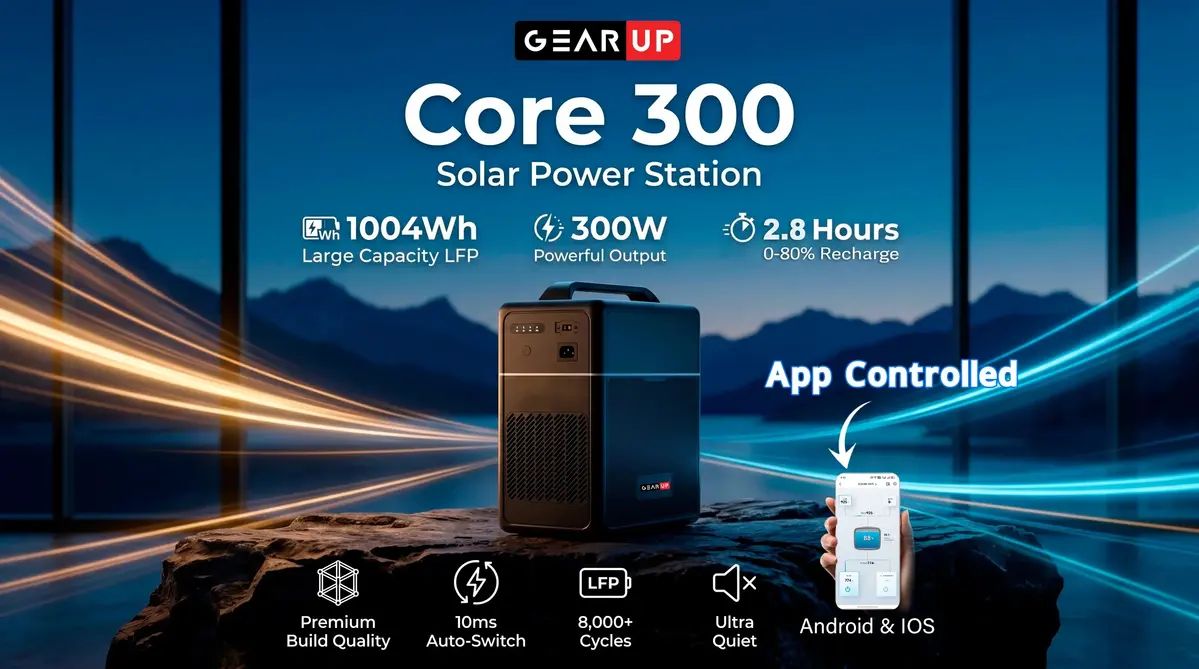
A portable power station bundles battery, controller and inverter in one box with USB and AC sockets. The GearUP Core 300 stores about 1 kWh and gives 300 W AC — enough for a fan, a router, lights and phone charging for a long evening — and recharges from mains or a panel. The YOUYO R100 is the small version for a desk. No electrician needed.
Sizing: start from the hours, not the watts
List what must run during an outage and for how long. A 12 W fan for 8 hours (96 Wh), a 10 W router for 8 hours (80 Wh), LED lights 15 W for 5 hours (75 Wh) and two phone charges (30 Wh) comes to about 280 Wh. Add a third for losses: 380 Wh of usable battery. That is a 12 V 40 Ah LFP battery, or a 500 Wh power station. To recharge that from sun in a day you need around 150 W of panel.
Three realistic setups
| Goal | Setup |
|---|---|
| One fan through the night | A solar fan with its own 25 W panel, e.g. the GearUP solar stand fan |
| Living room: fan, lights, router, phones | 500–1,000 Wh power station + 100–200 W panel |
| Small shop or home office | 12 V 100 Ah LFP + MPPT controller + 300 W panel + 500–1,000 W pure-sine inverter |
Where people waste money
- Buying a large panel with a PWM controller and a small battery — the panel's output is thrown away.
- Running a kettle or iron from a 300 W inverter. Heating appliances need kilowatts; keep them on mains.
- Lead-acid batteries cycled daily — cheap for a year, then replaced.
- Panels on a shaded wall. Even a corner of shade cuts output sharply; a roof or a south-facing ledge is the place.
Anything connected to mains wiring should be fitted by an electrician. Browse panels, controllers, batteries and power stations on the solar & power backup shelf — cash on delivery nationwide.
Frequently asked questions
What size solar panel do I need to run a fan and lights?
Around 100–150 W of panel to replace a day's use of a fan, a router and LED lights, paired with a 400–500 Wh battery or power station.
MPPT or PWM charge controller?
MPPT for anything above about 100 W of panel — it harvests 20–30% more from the same panel. PWM is acceptable for a single small panel.
Is a lithium battery worth it over lead-acid?
For daily use, yes. LiFePO4 lasts thousands of cycles and can be drained deeply; lead-acid cycled daily usually fails within two years.
Can a power station run a refrigerator?
A small fridge for a few hours on a 1 kWh station with a 300 W inverter is possible if the fridge's running draw is under the inverter rating; compressor start-up can trip smaller units. Check the fridge label first.