In this guide 7 sections
Load-shedding does not have to mean losing the internet. A router and a fibre ONU together draw about ten watts, which is why a small battery box — a mini DC UPS — can run them for a whole evening. This guide covers sizing, ports and the two or three details that trip most buyers up.
How a mini UPS differs from a normal UPS
A normal UPS converts battery power to 220 V AC and back down again inside your router's adapter, wasting energy and money. A mini DC UPS skips all that: it takes the adapter's place and feeds 5 V, 9 V or 12 V straight into the router. It is smaller, cheaper and lasts far longer per watt-hour.
Step 1: read the labels on your router and ONU
On the back of each device you will find something like "12V ⎓ 1A" or "9V 0.6A". Note the voltage and the plug size (most use a 5.5 × 2.1 mm barrel). A router at 12 V and an ONU at 12 V can share one UPS with two 12 V outputs, or one output through a DC Y cable; an ONU at 9 V needs a UPS with a separate 9 V port.
Step 2: size the battery
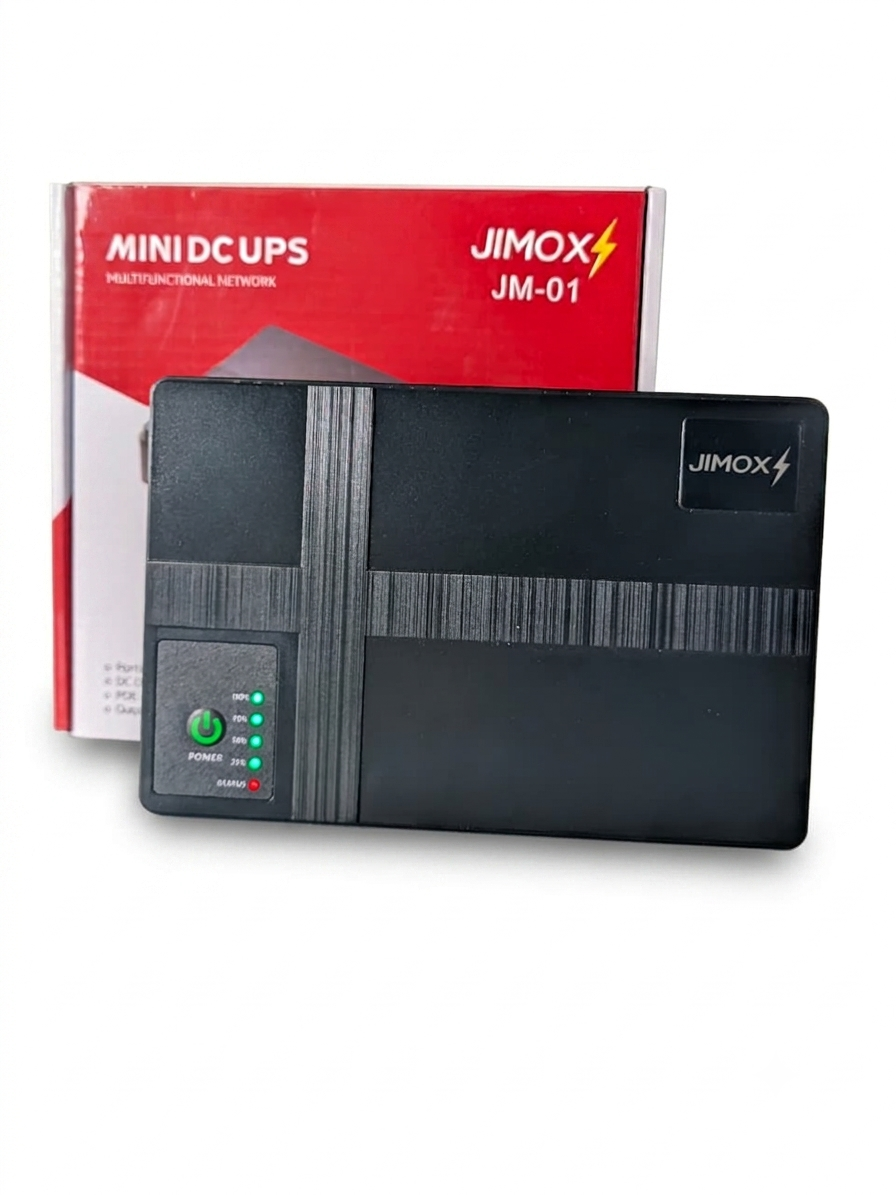
Runtime ≈ battery Wh ÷ load W. A router and ONU at 10 W on a 10,400mAh (about 38 Wh) unit such as the JIMOX JM-01 gives roughly three to four hours; a 20,000mAh unit like the Olax POE D8 Pro gives six to eight. Manufacturers quote runtimes for a router alone — halve them if you add an ONU.
Step 3: check the output watts, not just mAh
A gigabit router with four antennas can pull 15–18 W at start-up. A UPS rated for 12 W total will reset it. Look for the per-port amps: 12 V at 2 A (24 W) covers nearly every home router and ONU together. The SKE POE-36E-LFP is rated at 36 W and uses a LiFePO4 pack that tolerates being charged all day, every day.
PoE and cameras
If you run a PoE access point or IP camera, choose a UPS with a PoE output and check its voltage (24 V passive or 48 V 802.3af/at) matches the device. A plain 12 V port will not power a 48 V camera.
Mistakes that leave you offline
- Forgetting the ONU — the router stays up, the fibre box goes dark, and you have WiFi with no internet.
- Using a cable with the wrong barrel size or polarity. Match the included cables to each device before the first outage.
- Leaving the UPS unplugged "to save it" — it must stay on mains so it is full when the power fails.
- Expecting it to run a 220 V device. It cannot; that needs an inverter from the solar & power backup shelf.
Which one
| Setup | Pick |
|---|---|
| Router + ONU, evening outages | 10,400mAh multi-output — JIMOX JM-01 or WGP Optima 302 |
| Long outages, gigabit router, mesh | 20,000mAh, 24–36 W — Olax D8 Pro or SKE POE-36E-LFP |
| Camera or access point on PoE | A unit with the matching PoE voltage |
All of these ship cash on delivery anywhere in Bangladesh. Plug it in, leave it on, and the next outage is one you will not notice.
Frequently asked questions
How long will a mini UPS run a WiFi router?
Roughly battery Wh divided by load W: a 10,400mAh unit runs a router plus ONU for three to four hours, a 20,000mAh unit for six to eight.
Does a mini UPS power the ONU as well as the router?
Only if it has a second output at the ONU's voltage or you use a DC Y cable on a 12 V port. Check both labels before buying.
Can a mini UPS run a 220 V device?
No. It supplies 5 V, 9 V and 12 V DC only. Anything with a mains plug needs an inverter.
Should a mini UPS stay plugged in all the time?
Yes. It passes mains power through and keeps the battery full; LiFePO4 models are built for exactly that.