In this guide 6 sections
Gas pressure drops in the evening, the cylinder runs out mid-curry, or the flat simply has no line. Most households end up with one or two electric or portable appliances as backup. This guide compares the three common choices on cost, convenience and safety so you buy the one that fits your kitchen.
Electric kettle: the cheapest hot water there is
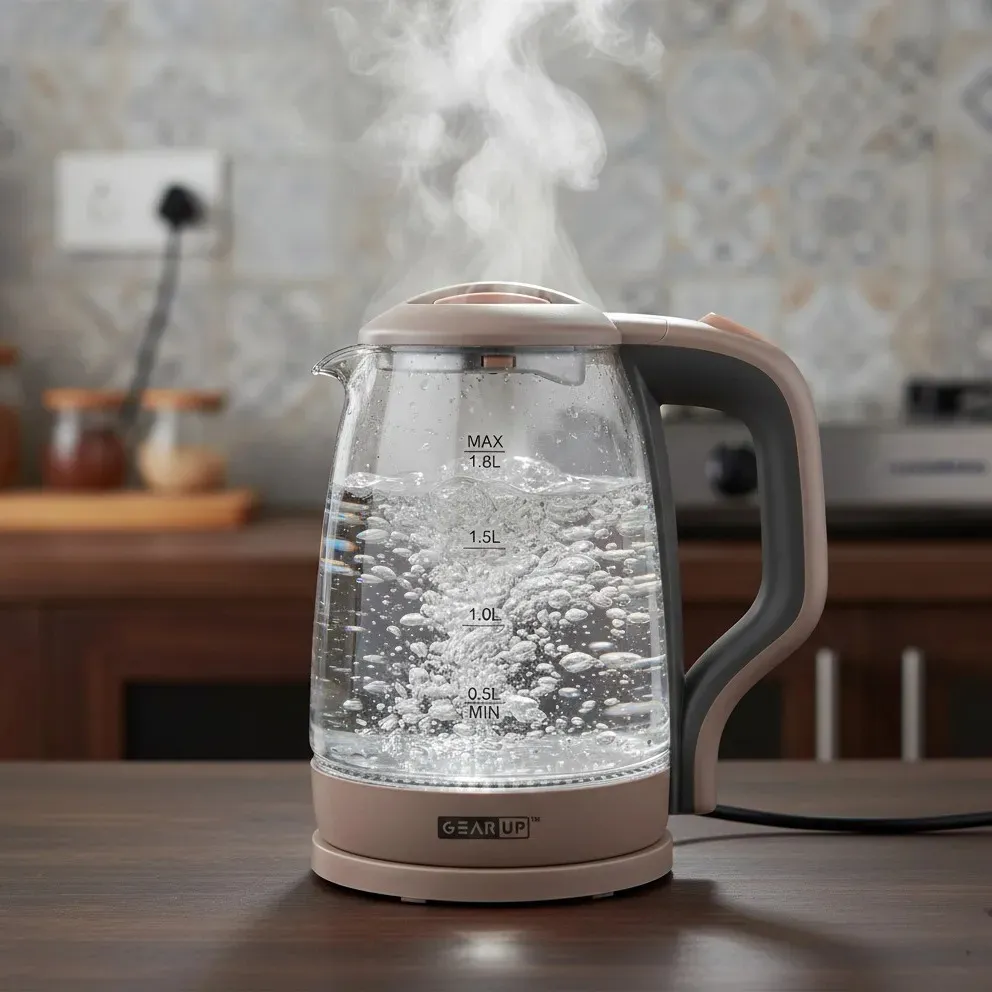
A 1,500 W kettle boils a litre in about three minutes and uses roughly 0.08 kWh doing it — a few taka. For tea, noodles, eggs and baby bottles it beats any stove. Look for a concealed element (far easier to descale with Dhaka's hard water), auto cut-off, dry-boil protection and 1.7–1.8 litres for a family. The GearUP GK15 glass kettle ticks all of those.
What to look for in a kettle
- Concealed element — a flat plate instead of a coil; hard-water scale wipes off rather than caking on.
- Glass or steel body — glass shows the water level and the scale; steel survives knocks. Plastic bodies can taint the taste.
- Auto cut-off and dry-boil protection — non-negotiable; they stop a forgotten kettle from burning out.
- 1,500–2,000 W — faster is not always better; above 2,000 W it needs a sturdy socket.
- Cordless base — the jug lifts off; far safer at a table with children.
Induction cooker: fast, efficient, picky about pans
Induction heats the pan directly, so it is faster than gas and wastes less. A 2,000 W unit boils water quicker than a burner and keeps a steady low heat for dal. The catch: it only works with magnetic-base cookware — stainless steel and cast iron usually, aluminium and most non-stick with aluminium bodies never. Test a pan with a fridge magnet. Wiring matters too: 2,000 W needs its own wall socket, not a multi-plug, and ideally a 16 A line.
Butane stove: the true outage backup
A card-type butane stove such as the Osel Gourmet Chef or Kovar K-202 works when both gas and electricity are out, which is exactly when you need it. Canisters are consumable — budget for them — and the stove must be used with a window open and never near the fridge or curtains. Any pan works.
Running cost, roughly
| Task | Kettle | Induction | Butane |
|---|---|---|---|
| Boil 1 L water | Lowest | Low | Moderate (canister) |
| Cook rice for four | — | Low | Moderate |
| Works in a power cut | No | No | Yes |
| Needs special pans | No | Yes (magnetic) | No |
Picks by household
- Bachelor or hostel room — kettle plus a double-deck electric cooking pot: noodles, eggs, steamed rice, one socket.
- Family kitchen with gas problems — induction cooker for daily cooking plus a pressure cooker (steel body, so it works on induction) to cut cooking time and power.
- Frequent power cuts — butane stove and a box of canisters kept in a cool cupboard.
Safety, briefly
- Nothing over 1,500 W on an extension cord or multi-plug.
- Kettles: never fill above the max line; steam from an overfilled kettle scalds.
- Butane: replace the canister only when the stove is cold, outdoors or by an open window.
Everything on the kitchen & dining shelf ships cash on delivery nationwide, with a 7-day easy return on faults.
Frequently asked questions
Which pans work on an induction cooker?
Only pans with a magnetic base — most stainless steel and cast iron. If a fridge magnet does not stick to the bottom, it will not heat.
Does an electric kettle use a lot of electricity?
No. Boiling a litre takes about 0.08 kWh, a few taka. It is the cheapest way to heat water at home.
Is a butane stove safe to use indoors?
With a window open and away from the fridge, curtains and gas lines, yes. Change canisters only when the stove is cold.
Can I run an induction cooker on a multi-plug?
No. A 2,000 W cooker needs its own wall socket; multi-plugs and thin extension cords overheat.